
The Story of King Mahabali and Vishnu’s Vamana Avatar
At the playground, Ananya’s cheeks were red with anger.
“Sid! What was that behaviour with Shanaya? She just wanted to play Lagori with us? Why didn’t you let her play?”
Sid crossed his arms, looking smug. “Because she’s so short and puny! How can she possibly strike the Lagori tower? What’s the point of letting her try?”
Ananya stomped her foot.
“That’s not fair at all! You don’t need to judge her. She is part of our school football team and is really good in sports.”
Before their argument got louder, Tatha, who had been watching from a bench, chuckled and walked over.
“My darlings,” he said in his gentle but firm voice, “don’t ever think size decides what someone can do. Looks can be very deceptive. Don’t you know the story of King Mahabali and the small boy who changed his world forever?”
“Yes Tatha, please narrate the story. Sid really needs to learn this lesson,” chuckled Ananya giving Sid a side glance.
King Mahabali’s Pride
Long ago, in Kerala, there was an asura king called Mahabali fondly called Maveli by the people of his kingdom. Mahabali, a devotee of Lord Vishnu, was the son of Virochana and the grandson of Prahalad. He was a righteous and charitable man and treated all his subjects equally. His rule was golden – people lived happily, there was no cheating, no lies, no hunger, no injustice. He grew powerful and popular among his subjects.
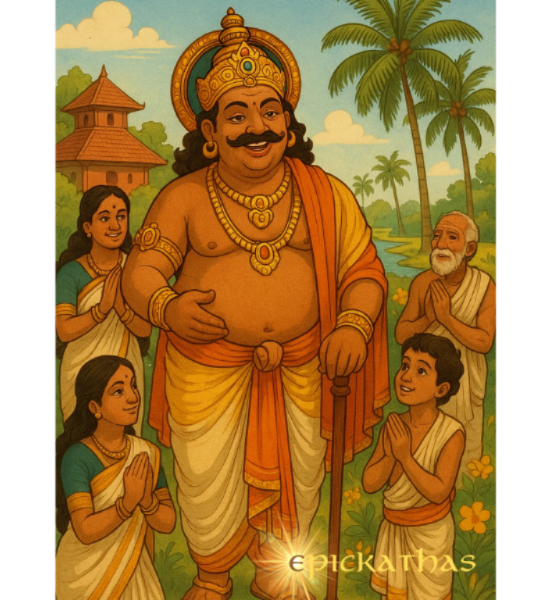
The Gods were worried with his growing popularity and having lost their kingdoms to him, wanted to dethrone him. So Lord Indra went to Lord Vishnu and requested him for help. Vishnu agreed to help Indra but on one condition – he would not fight a war or cause any injury to Mahabali.
The Small Boy Who Came Asking
Once Mahabali performed a yagya (sacrificial fire), at the end of which he offered gifts or charity to all those who attended the yagya. Towards the end, a small boy entered the yagya hall. He carried just a wooden umbrella and a gentle smile.
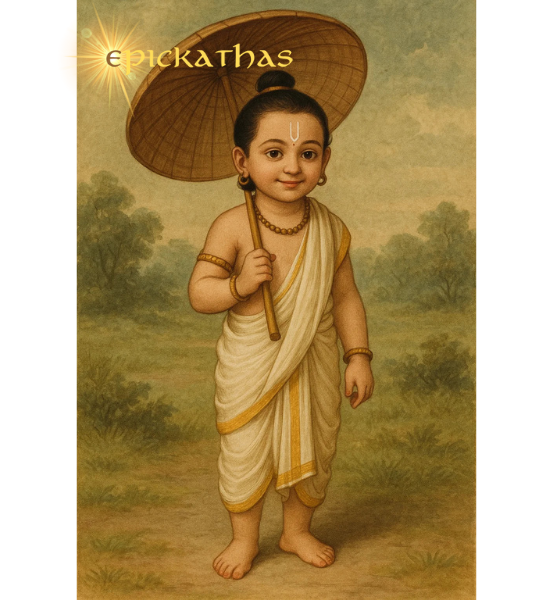
The boy asked politely:
“Great King, grant me just as much land as I can cover in three little steps.”
Mahabali laughed heartily.
“Three steps? Is that all? I could have given you entire villages, rivers or forests! But all you ask for is three steps? So be it.”
His wise guru, Shukracharya, whispered a warning:
“Your Majesty, this is no ordinary boy. He is Vamana, the avatar of Lord Vishnu. Think before you promise.”
But Mahabali being a just man, refused to go back on his words.
And so, he gave his word.
The Three Giant Steps
As soon as Mahabali said yes, Vamana began to grow taller and taller. The yagya hall trembled as the little boy grew taller than the mountains, his head brushing the skies. He took on the form of Trivikrama.
With his first step, he covered the entire earth. With his second, he spanned the heavens.
Then he turned to Mahabali and asked, “Where shall I place my third step?”
Mahabali, humbled but noble, bowed his head, “Lord, place it on me.”
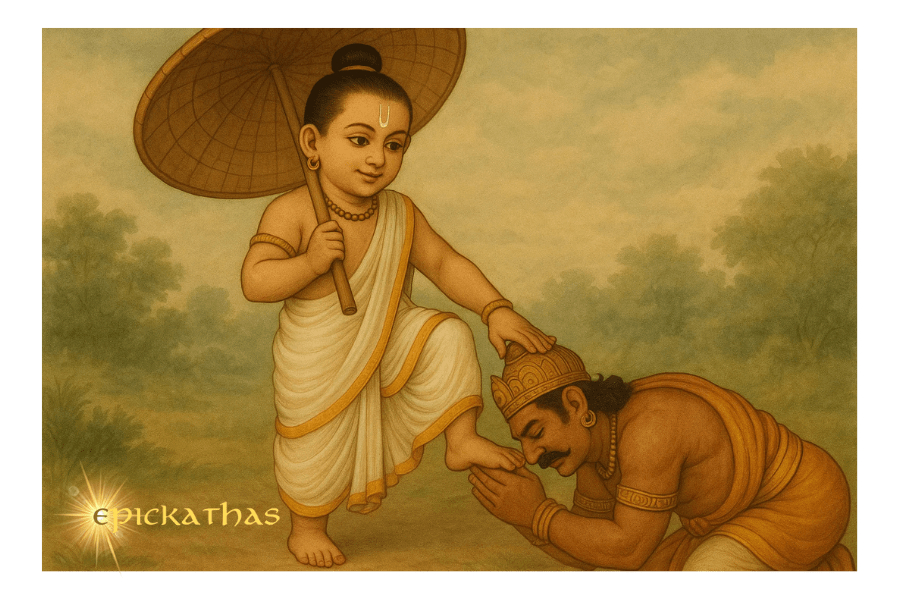
Vamana placed his foot on Mahabali’s head and pushed him down into the netherworld. But because Mahabali was so righteous and loved, Vishnu granted him a boon:
“Every year, you will return for ten days to your people in Kerala, to see if they are happy and living well. That would be celebrated with great joy and pomp as a festival.”
Why We Celebrate Onam
“That,” Tatha said, looking at Sid and Ananya, “is why people of Kerala celebrate Onam – to welcome their beloved King Mahabali back home. They decorate with flowers, cook feasts, play games and show him that they still live in joy and prosperity.”
Sid frowned thoughtfully.
“So I learnt my lesson, Tatha. Never underestimate someone because of their size or looks. Even the mightiest king was outsmarted by what he thought was just a little boy.”
“Yes Sid, that’s correct” said Tatha.
Ananya smiled and tugged Sid’s sleeve.
“See? Let me call Shanaya to play tomorrow. Maybe she’ll even surprise you by striking the tower in one shot.”
Sid scratched his head and laughed sheepishly.
“Okay, okay… I got your point, now don’t rub it in!”
And as the children went back to their game, the spirit of Onam – the joy of fairness, humility, and togetherness – lived on in their play.
Moral: True strength is not always in size or power, but in humility and fairness.

 Epickathas
Leave a reply to Vriddhi Kapil Panveli Cancel reply